
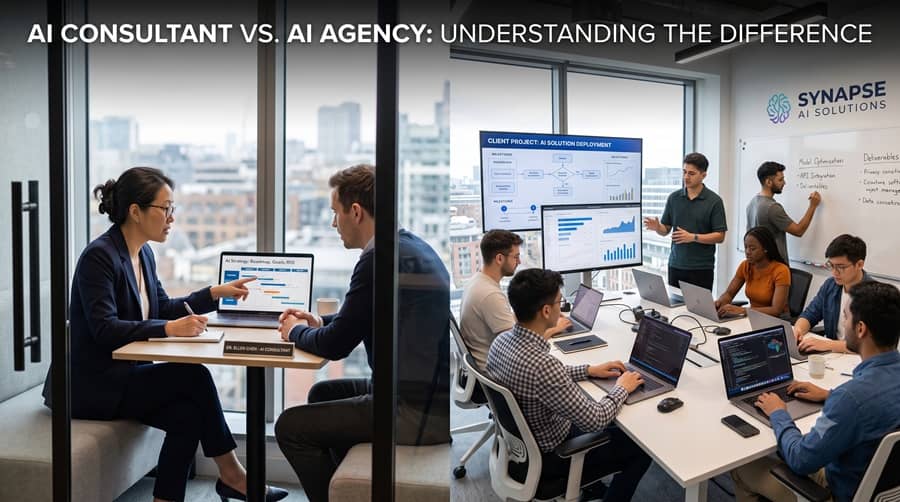
I get some version of this question almost every week now: should I hire an AI consultant, or an AI agency? People have heard the hype, they’ve watched a demo or two, and they know there’s real value sitting somewhere in their business. What they don’t know is who to trust with it. Pick wrong and you either burn a few thousand dollars on a strategy document nobody executes, or you sign a retainer for a team you didn’t need yet.
I’ve sat on both sides of this line. 2Surge Marketing is a digital marketing agency – we run web development, SEO, and paid ads for clients day to day, with a team, project managers, and the overhead that comes with all of it. But I also do hands-on AI consulting work myself. I’m the one installing Claude Code, standing up MCP servers that authenticate against Google Cloud Console for Search Console data, and configuring agentic platforms for clients. I don’t hand that off to somebody else and wait for a status update. Most people writing about consultant-versus-agency have only ever lived one side of it. I’ve lived both, and the honest answer depends less on which model is “better” and more on what you actually need done.
An AI agency is not the same thing as an AI agent. An agency is a company you hire. An agent is a piece of software – an autonomous system built to run a specific task on its own. Search results blur these together constantly, so if you came here trying to figure out what a “customer service AI agent” is, that’s a different article.
What an AI consultant actually does
An AI consultant is usually one person, sometimes with a subcontractor or two they pull in for specialized work. Their value is depth, not headcount – years spent inside one corner of AI, whether that’s natural language processing, machine learning for data analysis, or automation built specifically for marketing workflows.
Strategy in, blueprint out
A consultant looks at how your business actually runs today, finds where AI could realistically help, and tells you how to do it. That’s the job. They audit your workflows and map out where an AI system could speed up content production, tighten your ad spend, or handle first-line customer questions.
Say a consultant comes in and looks at a small business’s content pipeline. They might recommend using Claude Code to draft blog posts off Clearscope outlines, or setting up N8N as part of a broader marketing automation setup – pulling data out of Google Analytics and generating a weekly performance report automatically. What you get at the end is a strategy document, not a working system.
Here’s the part people don’t expect: consultants generally don’t build anything. They hand you the blueprint. Then it’s on you to find someone – your own team, a contractor, an agency – to actually build and run what they recommended. I’ve watched clients pay good money for a sharp, well-written strategy doc that then sat in a shared drive for eight months because nobody on staff had the time or the skill to execute it. That’s not a hypothetical. That happens constantly.
When hiring a consultant is the right call
A consultant is a strong first move if you genuinely don’t know where to start. They’ll help you figure out what’s worth automating before you spend real money building anything. And if you already have developers or IT staff who can handle implementation but nobody who understands AI strategy specifically, a consultant fills exactly that gap.
Take a small e-commerce shop in Frisco trying to personalize product recommendations. A consultant looks at their sales data, their WooCommerce setup, and how their customers segment out. They might recommend an open-weight model like DeepSeek for the recommendation engine, then map out exactly how product data and customer behavior should feed into it and back out to the site. What they won’t do is set up the DeepSeek server themselves. They’ll tell you precisely how it needs to work, and leave the wiring to someone else.

What an AI agency does differently
An agency – 2Surge included – is built for the whole job, not just the diagnosis. We have developers, data people, project managers, sometimes marketing specialists, all under one roof. That means strategy, build, deployment, and upkeep can all happen under a single contract instead of getting handed off between three different vendors.
End to end, not blueprint and goodbye
Hire an agency and you’re generally getting all of the following:
- Strategy work similar to what a consultant would deliver, but folded into a larger engagement
- The actual build: custom MCP servers for Search Console data, Python scripts for data entry, agentic platforms like Open Claw configured to handle support queries
- Deployment into your existing systems, not a proof-of-concept sitting on someone’s laptop
- Training your team on how to run and troubleshoot what got built
- Ongoing maintenance – because data sources shift, APIs get deprecated, and models drift and need retraining
Picture a mid-sized law firm in Dallas that wants a system to summarize legal documents using an LLM. An agency sets up the cloud infrastructure, integrates something like Qwen Code, builds the interface, and then keeps an eye on performance and security for as long as the contract runs. That’s not a one-person job. It never was.
What it costs you
Scale and breadth cost money. Agencies run more expensive than solo consultants because you’re paying for a team and everything that keeps a team functioning. Decisions can also move slower – more people in the room means more coordination, and coordination is not free.
Agencies overselling what’s really happening under the hood is a real, recurring problem. “AI-powered” gets slapped on what’s actually a Zapier workflow with a ChatGPT API call bolted onto it. That’s not AI development. That’s automation wearing an AI costume. If a vendor can’t tell you exactly which models they’re using, what the data pipeline looks like, and how the infrastructure is set up, keep asking until they either answer or you walk.
Combining the two – and when that’s actually smart
A lot of businesses do best with both, in sequence rather than at the same time.
Consultant first, agency second
Hire a consultant to get the strategy and the roadmap sorted. They define the problem, pick the right tools, and spell out the technical requirements. Once that plan exists, an agency takes it and builds.
This order saves money. You’re not paying agency rates during the exploratory phase, when nobody knows yet exactly what’s getting built. Once the plan is locked, the agency executes against something concrete instead of guessing. A restaurant chain in Plano, for instance, might bring in a consultant to figure out whether AI can forecast ingredient needs and cut waste. The consultant delivers the plan. Then the chain hands it to an agency to wire the predictive model into their existing POS and inventory systems.

The fractional AI lead option
There’s a third model worth knowing: a fractional AI lead. This is usually a senior consultant working a fixed number of hours per week or month, acting like an in-house AI director without the cost of a full-time hire. They vet agencies on your behalf, manage the project, and keep the whole thing aligned with what your business actually needs – the kind of day-to-day judgment call an agency team, moving by committee, isn’t always built to make fast.
Consultant vs. agency, side by side
| Feature | AI Consultant | AI Agency |
|---|---|---|
| Team size | Usually 1-2 people | A dedicated team – developers, data specialists, project managers |
| Primary focus | Strategy, audits, proof-of-concept recommendations | Strategy plus build, deployment, and maintenance |
| Scope of work | Tells you what to do | Does it for you |
| Cost | Lower upfront, usually project-based or hourly | Higher, retainer-based or larger project fees |
| Speed on judgment calls | Fast – one person deciding | Slower – team coordination adds friction |
| Long-term support | Limited to none | Ongoing maintenance and updates |
| Accountability | Ends at strategy delivery | Extends to system performance and outcomes |
How to actually decide
This comes down to your internal resources, your goals, and your budget – in that order, honestly.
What do you already have in-house?
If you’ve got developers or IT staff who can build and maintain a system, a consultant supplying the strategy might be all you need – they point, your team builds. If your team understands AI concepts but is missing depth in one specific area, a specialist consultant closes that gap. If you have zero internal AI experience, an agency that can carry the whole thing is usually the safer bet.
What are you actually trying to do?
Still figuring out whether AI is worth it for, say, SEO keyword research through Surfer SEO? Start with a consultant. Already know you need a working AI agent handling Tier 1 customer support? Skip the exploratory phase – go straight to an agency that can build and deploy it. A quick audit is a consultant’s job. Ongoing system management and continuous improvement is an agency’s.
What’s the budget, really?
Consultants cost less upfront, which makes them the accessible option when you’re testing the water. Agencies mean a bigger check, because you’re funding the full build and everything after it.
Red flags that apply to either one
Watch for vague promises about how a solution actually works for your business – buzzwords instead of specifics are a problem either way. A few concrete things worth checking before you sign anything:
- Ask them to name the actual models and platforms – Anthropic’s models, GPT, Qwen, DeepSeek, whatever. “Our proprietary AI” with no further detail means dig deeper or walk away.
- Ask about process – how they gather requirements, how they test, what deployment actually looks like. No answer, or a vague one, tells you something.
- Ask how they handle your data – if nobody’s asking about data quality or integration before quoting you a price, that’s backwards.
- For agencies specifically, ask about the maintenance plan – AI systems are not “set it and forget it,” and anyone who implies otherwise hasn’t run one long enough to know better.
Then there’s AI-washing, which deserves its own line: watch for agencies dressing up a couple of chained API calls as an “AI-powered enterprise solution.” If it’s just ChatGPT plus Zapier under a nicer label, you’re paying premium rates for something you could largely build yourself with a weekend and a decent tutorial.
What I tell small and mid-sized businesses specifically
Resources are tighter here, so the stakes on this decision feel bigger. My honest read, for most of the North Texas businesses I work with: start with a consultant or a fractional arrangement. Figure out what’s actually worth automating, and what it’s actually worth to your business, before you’re paying agency rates to build it.
At 2Surge, we usually start client work with a discovery phase that functions a lot like a standalone consulting engagement – we spend real time on their business, their goals, their existing stack, before anyone touches a build. Skipping that step is how you end up with an expensive system solving a problem nobody actually had.
Ownership matters more than people think
With a consultant, accountability usually ends the moment they hand over the strategy doc. What happens next – implementation, results, all of it – is yours. With an agency, accountability for the running system, and often for the outcomes it produces, stays with them.
Who owns the code, who’s on the hook for security updates after launch, and what happens if the relationship ends. These aren’t small print. They’re the terms that decide whether you’re stuck rebuilding from scratch in eighteen months.
Structuring a bigger engagement in phases
For anything substantial, break it into phases with real milestones instead of one big undefined scope:
- Discovery and strategy – define the opportunity, assess readiness, produce a roadmap. Lower, fixed fee.
- Proof of concept – a small working prototype that tests whether the idea actually holds up. Moderate, fixed fee.
- Full implementation – build and deploy the real system, train the team, document it. Higher cost, usually milestone-based.
- Ongoing maintenance – keep it stable, tune performance, adapt as things change. Monthly retainer.
Phasing it this way keeps risk contained, and it gives you an exit point at every stage if the early findings say the project isn’t worth finishing as originally scoped.
Whichever way you go, the partner you want is the one who’ll show you exactly how their solution works for your business specifically – not the one with the smoothest pitch deck.
About the Author